


Global Regulators Open Doors to New Casino Entrants

Recommended casinos
Key Takeaways
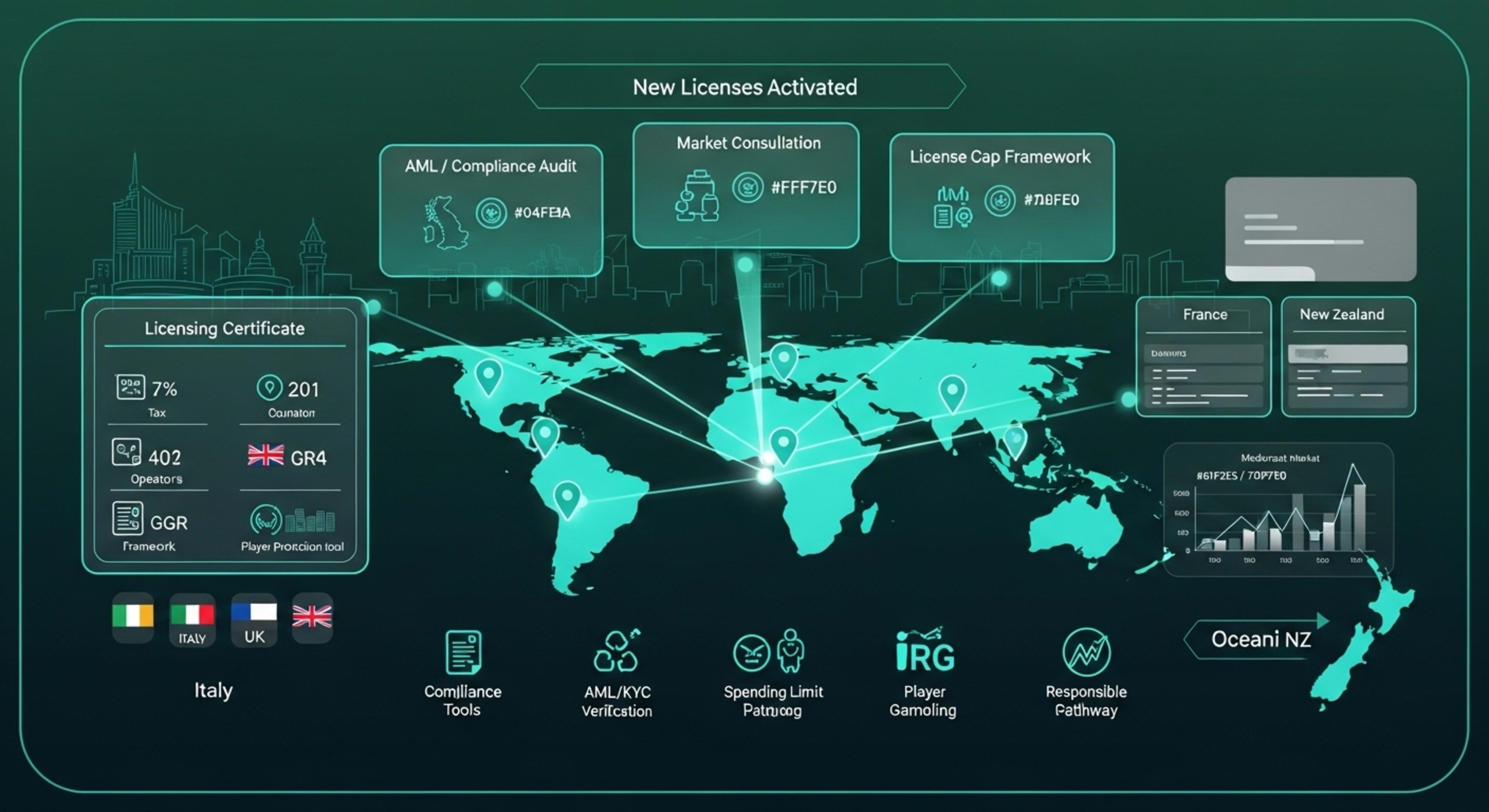
- Italy's new online gambling regime activates 46 operator licenses, signaling a structured entry for international brands into Europe's second-largest iGaming market.
- UK Gambling Commission reinstates Victoria Gate Casino's license following AML enhancements, underscoring rigorous compliance as a gateway for sustained operations.
- France launches a six-month consultation on iCasino regulation, paving the way for potential market openings in 2025 amid stakeholder alignment on player protections.
- New Zealand's Online Casino Gambling Bill advances, proposing a capped 15-license framework to balance growth with harm minimization in Oceania.
Italy Activates New Online Gambling Regime with 46 Licenses
The Italian Ministry of Economy and Finance (MEF) has launched its revamped online gambling framework, effective November 14, 2025, granting 46 nine-year concessions to operators at €7 million each, plus a 3% annual tax on net revenue. This follows a tender process that exceeded expectations, with ADM's gaming division head, Mario Lollobrigida, noting the sector's 10% Q1 2025 growth as a key driver of participation. Successful applicants include established European firms like Entain and Kindred Group, alongside emerging entrants positioning for Italy's €5 billion annual market.
The regime replaces the fragmented prior system, introducing unified oversight of slots, table games, and live casino offerings, with stricter advertising and responsible gambling mandates. Parent companies such as Flutter Entertainment, which holds a 10% share, anticipate scaling to 25% within five years through localized content partnerships. Launch timelines target immediate operations, with full integration by Q1 2026. For players, this means enhanced fund security and self-exclusion tools via a national registry; regulators gain €1.5 billion in projected 2025 taxes; and stakeholders benefit from reduced black-market infiltration, previously estimated at 15%. In a competitive landscape dominated by domestic monopolies, this fosters innovation while curbing unlicensed operators.
Source: SBC News
UKGC Restores Victoria Gate Casino License Post-AML Overhaul
The UK Gambling Commission (UKGC) lifted the suspension of Victoria Gate Casino's operating license on November 25, 2025, just weeks after halting activities due to anti-money laundering (AML) deficiencies. Operated by Rank Group, a subsidiary of Guoco Leisure with deep roots in UK land-based gaming, the Leeds venue—Europe's largest 24-hour casino—implemented comprehensive reforms, including advanced transaction monitoring and staff training aligned with the Gambling Act 2005's enhanced due diligence requirements.
This milestone highlights the UK's zero-tolerance stance on financial crime, where license approvals hinge on robust AML frameworks amid a £14.3 billion annual sector contribution. Rank Group's ownership structure, bolstered by its Grosvenor Casinos portfolio, positions it competitively in the regulated landscape, where compliance lapses cost operators millions in fines yearly. The casino resumes full operations immediately, with no launch delay, emphasizing seamless player access to 80+ tables and 100 slots. Implications include strengthened trust among patrons through GamStop integration; regulatory reinforcement of the Prevention of Money Laundering Regulations; and industry-wide signals for proactive audits, potentially averting similar disruptions for new entrants in the UK's mature market.
Source: SBC News
France Commences iCasino Regulation Consultation for 2025 Entry
France's Budget Ministry launched a six-month public consultation on November 20, 2025, to shape the legalization of online casinos, following an October amendment to the National Assembly's Finance Bill. Chaired by Minister Laurent Saint-Martin, the process involves 50 stakeholders—including FDJ, PMU, and player protection groups—to define licensing, taxation (around 55% GGR), and RG standards, targeting a mid-2025 rollout.
ANJ, the gambling regulator, oversees this shift from poker/sports-only to full iCasino access, addressing an illegal market worth €1.5 billion. No specific operators are pre-approved, but international firms like Evolution Gaming are eyeing partnerships with locals like Partouche to build compliant platforms. Ownership details remain fluid, pending tender, in a market projected to add €2 billion in regulated revenue. Players gain ARJ-affirmed protections, such as mandatory deposit limits; regulators achieve harmonization with EU peers; stakeholders anticipate 10-15 licenses boosting tourism. Competitive dynamics favor tech-savvy entrants, with timelines aligning launches post-consultation by July 2026, curbing offshore dominance.
Source: SBC News
New Zealand Advances 15-License Online Casino Framework
New Zealand's government tabled the Online Casino Gambling Bill on November 24, 2025, clearing its first reading and proposing a Department of Internal Affairs (DIA)-issued 15-license cap for online operators, effective post-2026 referendum approval. This builds on the 2003 Gambling Act, introducing a 12.5% GGR tax ring-fenced for harm prevention via the Gambling Harm Minimisation Fund.
Tabcorp and Sky City Entertainment, local giants with land-based assets, are leading potential applicants, partnering with global suppliers like Playtech to deliver compliant platforms. The framework mandates RG innovations, including AI-driven session monitoring, in a market valued at NZ$300 million. Ownership transparency via public registries ensures accountability, with launches slated for Q3 2026. Players benefit from geo-fenced access and mandatory cooling-off periods; DIA enforces equity in a nascent landscape; operators gain legitimacy, projecting NZ$500 million in new revenue. This caps explosive growth while prioritizing public health, differentiating from Australia's fragmented model.
Source: SBC News